Demystifying Indexed Universal Life (IUL) Loans
Updated:

Table of contents
For decades, the ultra-wealthy have utilized a wealth preservation framework affectionately (and somewhat morbidly) known as "Buy, Borrow, Die." The premise is simple: acquire appreciating assets, never sell them to avoid triggering capital gains taxes, borrow against them to fund your lifestyle, and eventually pass the assets to your heirs with a stepped-up cost basis.
When applied to life insurance, this strategy relies on borrowing against the accumulated cash value of an Indexed Universal Life (IUL) policy. However, this isn't a simple bank loan. When you borrow against an IUL, you aren't actually withdrawing your money; you are collateralizing your cash value and taking a loan directly from the insurance carrier's general fund.
What's the difference between a wash loan and an alternative loan?
Both borrow from the insurer against your cash value; the difference is what that cash value earns while the loan is out. A wash loan credits it the same rate the loan charges, so borrowing costs about nothing. An alternative loan keeps it in your index account. At a 5% loan rate, if the market rises 8%, the account is credited 8% and charged 5%, netting 3%; if it drops, it is credited 0% and still charged 5%, netting −5%. With a wash loan, the cash value backing the loan no longer grows with the index: net of the interest, it stays frozen while the loan is out, which is an opportunity cost.
When it comes time to access your liquidity, insurance carriers typically offer two distinct mechanisms.
The Wash Loan (Zero Wash) A wash loan is designed to be a net-zero transaction. The carrier might charge you a fixed interest rate to borrow the money, but they simultaneously credit that exact same rate to the portion of your cash value collateralizing the loan. Your net cost to borrow is theoretically 0%. This is the conservative route, ensuring you can access tax-free liquidity without worrying about fluctuating interest rates eating into your baseline.
The Alternative Loan (Participating / Index Loan) This is where the math gets aggressive. With an alternative loan, the carrier charges you a set or variable loan rate (for example, 5%), but the cash value you collateralized remains fully invested in your chosen index crediting strategy.
- The Upside: Whenever the index credits more than the loan rate, as in the 8% year above, you earn more on the money than you pay to borrow it. You achieve positive arbitrage, meaning your cash value continues to compound as if you never touched it.
- The Downside: If the market goes flat and your policy credits 0% due to the protective floor, you still owe the full loan interest, and it keeps accruing every year the market stays flat. You experience negative arbitrage, meaning the loan costs you money out of pocket, dragging down your net cash value.
Do you have to repay an IUL loan?
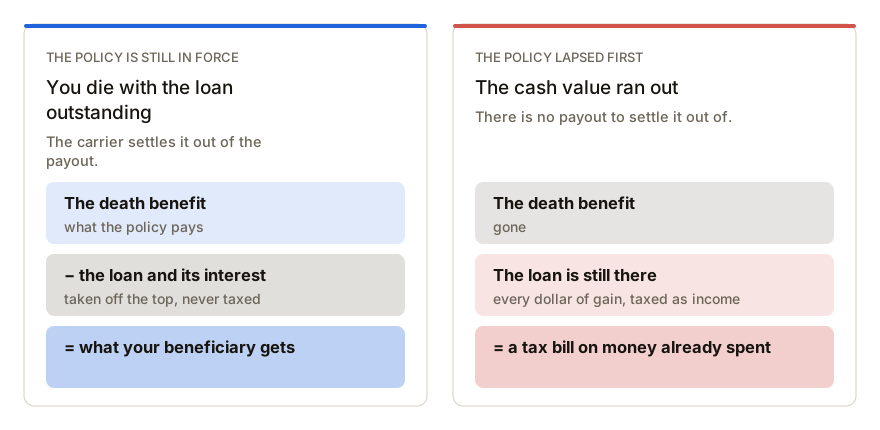
No. There is no repayment schedule: if you never repay the loan, the insurer subtracts the balance and its interest from the death benefit before paying your beneficiaries. The catch is that an unpaid loan keeps growing, and if it grows large enough to lapse the policy, the tax consequences below apply.
For anyone naturally averse to debt, the idea of collateralizing assets to take out a massive loan can sound like a financial nightmare. However, IUL policy loans are non-recourse: the insurer can collect only from the policy itself, never from you or your other assets.
There are no credit checks to obtain the loan, and you dictate the payment terms: you can repay any amount whenever you like, or nothing at all while you are alive.
The SBLOC Comparison: Borrowing Against Assets Isn't Uncommon
To understand why anyone would borrow their own money, it helps to look at how this is traditionally done outside of life insurance. The classic "Buy, Borrow, Die" strategy is usually executed using a Securities-Backed Line of Credit (SBLOC) tied to a standard stock portfolio.
Taking a loan against your assets is a very common wealth management practice. With an SBLOC, you pledge your stocks to a lender for a revolving credit line. These loans typically carry variable interest rates tied to a benchmark like the 1-Month SOFR (Secured Overnight Financing Rate) plus a lender margin. Depending on the size of the portfolio and current Fed policies, SBLOC borrowing costs frequently hover between 6% and 8%.
While an SBLOC is highly efficient, it carries a severe edge-case risk: if the stock market crashes, the value of your collateral plummets, triggering a dreaded margin call that forces you to liquidate assets at the absolute worst time.
An IUL loan fundamentally removes this specific vulnerability. Because the IUL is structurally built with a 0% floor, a market crash will not reduce your core cash value. This functional difference eliminates the traditional margin call risk, though you trade away the unlimited upside of the stock market to get that stability.
What happens if an IUL lapses with a loan outstanding?
The policy ends, and the loan you never repaid can become taxable. A policy lapses when its cash value drops to zero; the IRS then stops treating what you borrowed as a loan, and every dollar of gain you took out is taxed as income that year. And it tends to arrive at the worst possible time. A policy lapses because nobody paid in enough after the insurer's warning notice, and anyone with the cash for a tax bill that size could almost certainly have paid that premium instead, keeping the policy in force and the loan untaxed.
If borrowing tax-free money with no required repayment schedule sounds like a financial cheat code, you must understand the failure conditions.
The primary danger of an IUL loan is policy lapse. As you age, the internal Cost of Insurance (COI) charges inside the policy increase significantly. If you take out massive alternative loans, and the market subsequently suffers a decade of stagnation, you will suffer years of negative arbitrage. The compounding loan interest, combined with rising COI charges, will aggressively cannibalize your cash value.
Once nothing remains, the policy lapses, and you could be handed a massive tax bill in your 70s or 80s for money you spent a decade ago.
Should you buy an IUL for its loans? Opportunity cost and carrier control
Opinion is sharply divided. Agents point to borrowing tax-free from a policy that stays in force; skeptics point to the early charges and commissions, and to loan terms the carrier can change. Even in a max-funded policy, it depends heavily on the numbers: the tax-free advantage is not always worth the upfront and ongoing charges, so it is best to run your own policy through a simulation before you decide.
The agents' case is simple: cash you can reach tax-free while the underlying asset keeps compounding. The skeptics' case takes more explaining, and rests on two structural realities that complicate that pitch.
First is the sheer opportunity cost. IULs have high upfront commissions and ongoing insurance charges. A significant chunk of your early premiums goes directly to the agent and the carrier, not your cash value. Skeptics argue that if those early premium dollars had simply been invested and left alone, they would have compounded so significantly over 10 to 20 years that the extra growth could offset much of the tax advantage the loan promises later on.
Second, the mechanics of the loan are entirely controlled by the carrier. Agents often pitch the safety of a wash loan or the positive arbitrage of an alternative loan as mathematical certainties. In reality, wash loans are not perfectly guaranteed in perpetuity; the fixed loan interest rate and the crediting rate on the collateral can often be adjusted by the carrier depending on the specific contract limits.
Similarly, alternative loans rely heavily on high caps and participation rates to achieve that positive arbitrage. If a carrier decides to lower the cap on your index strategy to 6% while your loan rate stays at 5%, your potential arbitrage spread is effectively squashed. The carrier always reserves the right to shift the risk of underperformance back onto you.
Ultimately, borrowing against an IUL is not a passive strategy. It is a highly active financial tool that demands the policy be max-funded, meticulously designed, and strictly monitored to prevent the backend mechanics from quietly unwinding your wealth.
Have your own illustration read
Drop the PDF in and we will read its own loan terms, work out what your beneficiary would receive with a loan outstanding, and show you what would have to happen for the tax to land instead.
For the easiest experience, complete your analysis on a computer.
Drop your illustration here
or click to choose a PDF, up to 25MB