The Evolution of Life Insurance: Why Indexed Universal Life (IUL) Is Designed the Way It Is
Updated:

Table of contents
- Step 1: Term Life Insurance (1840s) — Simple, But Temporary
- Step 2: Traditional Whole Life Insurance (1850s) — Permanent, But Rigid and Low-Yield
- Step 3: Universal Life (1979) and Variable Universal Life (1985) — Growth, But Uncapped Risk
- Step 4: Indexed Universal Life (1997) — The Engineered Balance
- How does an IUL work?
- Why is an IUL so complex?
- Historical Evolution at a Glance
- Is the complexity of an IUL justified?
If you look at an Indexed Universal Life (IUL) policy illustration today, it can feel overwhelmingly complex. With caps, participation rates, crediting floors, indices, and loan options, it is easy to wonder: Why did insurance companies make this so complicated? Are they trying to trick us?
To understand why IUL exists in its current form, we have to look at the history of life insurance in the United States. IUL was not created out of thin air to confuse consumers—it was engineered as the latest link in a nearly 200-year chain of problem-solving. Each iteration of life insurance emerged to fix a fundamental flaw in the product that came before it.
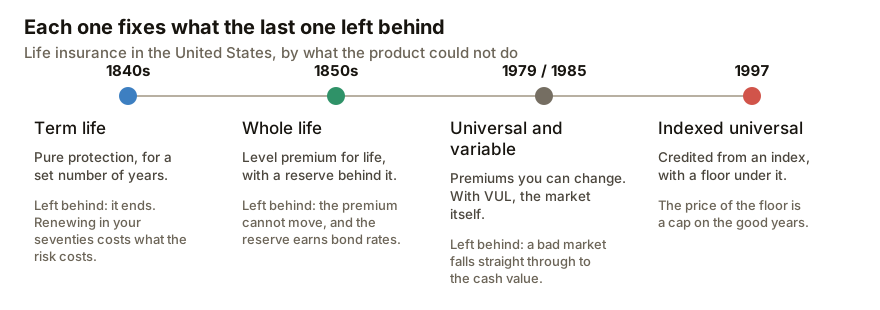
The dates are the ones usually given for each product's arrival in the US market. Exactly which contract was first is disputed in places, and is not something the argument here turns on.
Step 1: Term Life Insurance (1840s) — Simple, But Temporary
In the mid-19th century, modern commercial life insurance took off in the United States. Early policies were modeled after simple Term Life Insurance: you paid a low monthly premium, and if you died within a set window (such as 10 years), your family received a cash payout. If you survived the term, the contract ended.
The Limitation: The Expiration Problem
As human mortality increases exponentially with age, term insurance created a major problem for aging policyholders: it eventually expires.
If a policyholder reached their 60s or 70s and still needed coverage for business obligations or lifelong dependents, renewing a term policy became astronomically expensive. Consumers demanded a policy that would stay with them for their entire life.
Step 2: Traditional Whole Life Insurance (1850s) — Permanent, But Rigid and Low-Yield
To solve the temporary nature of term insurance, U.S. insurers introduced Whole Life Insurance in the 1850s. By combining pure insurance protection with a mandatory savings component (Cash Value), Whole Life offered level pricing for life and guaranteed death benefits.
The Limitations: Rigidity and Low Crediting Rates
While Whole Life solved the lifetime coverage problem, it created two major financial drawbacks:
- Strict Premium Rigidity: Whole Life requires fixed, unchangeable premium payments. If a policyholder faces financial hardship, they cannot temporarily lower or skip payments without borrowing against the policy or causing it to lapse.
- Low Crediting Rates: Whole Life cash values are backed predominantly by conservative institutional bonds and treasury bills held by the insurer. During periods of high inflation or stock market rallies (such as the post-WWII economic boom), Whole Life crediting rates appeared sluggish. Policyholders watched the wider economy surge while their cash values yielded modest conservative returns.
Consumers began asking: Why can't my cash value participate in economic growth, and why can't I adjust my payments when life happens?
Step 3: Universal Life (1979) and Variable Universal Life (1985) — Growth, But Uncapped Risk
By the late 1970s and 1980s, high inflation and skyrocketing interest rates forced the insurance industry to modernize. Insurers responded with two pivotal innovations:
- Universal Life, generally credited to E.F. Hutton around 1979, unbundled the policy: the premium, the insurance charge and the savings became separate pieces, so a policyholder could adjust what they paid and what they were covered for.
- Variable Universal Life, which arrived in the mid-1980s on top of earlier variable products, let policyholders put their cash value directly into market sub-accounts, much like mutual funds.
With VUL, policyholders could finally capture full stock market returns and enjoy complete premium flexibility.
The Limitation: Defeating the Purpose of Insurance
VUL gave consumers market upside, but it also transferred 100% of the market risk from the insurance company directly onto the policyholder.
If the stock market crashed, a VUL policy's cash value could plummet. Because internal insurance costs rise as a policyholder ages, a sudden collapse in cash value forced policyholders to inject massive amounts of extra cash just to keep their policies alive.
For many, VUL defeated the core purpose of buying life insurance: peace of mind and financial protection.
Step 4: Indexed Universal Life (1997) — The Engineered Balance
By the late 1990s, the industry recognized a major market demand: consumers wanted the equity-linked growth potential of VUL, but they demanded the principal safety of Whole Life, alongside the payment flexibility of Universal Life.
The first Indexed Universal Life (IUL) policy is generally credited to Transamerica, in 1997.
How does an IUL work?
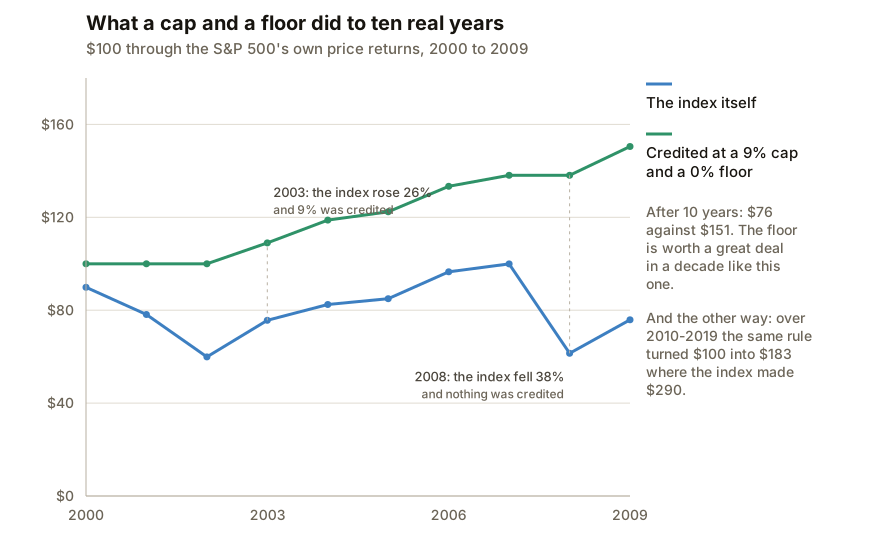
An IUL credits interest based on an index, with a cap on strong years and a floor, often 0%, on weak ones, so the account shares part of the market's gains without being credited a loss.
IUL achieves its unique balance—upside potential with zero market downside—through institutional financial engineering:
- Your money is not in the market. When you pay a premium into an IUL, the insurer puts the large majority of the premium, after charges, into its own conservative bond portfolio. That is what secures your principal.
- Options buy the upside. A small slice of the remainder buys call options on an equity index, such as the S&P 500. How the two are split varies by carrier and moves with interest rates — when bonds yield more, there is more money to spend on options, which is why caps rise and fall with rates rather than with the stock market.
- The Trade-Off (Caps and Floors):
- The Floor (Safety): If the index drops by -30%, the options expire worthless, but the yield from the underlying bond portfolio covers the cost—resulting in a 0% return rather than a negative one.
- The Cap (The Cost of Safety): If the index surges +25%, your return is capped at a maximum limit (e.g., 8%–10%). The insurer retains the excess profit to fund the options strategies that guarantee your 0% floor.
What doesn't the IUL floor protect against?
A 0% credit is not a 0% year. The floor stops the crediting from going negative. It does not stop the charges, which come out every year whatever the market did — the cost of insurance, the policy fee, the per-unit charge. In a long enough flat stretch those charges exceed what was credited and the cash value falls anyway. That is the thing to check on your own illustration, and it is what our article on how life insurance works works through.
And the cap is not free. The chart above is the decade the floor was built for. Run the same 9% cap and 0% floor through 2010 to 2019 and it turns $100 into $183 where the index itself made $290. Neither decade is a forecast. They are the two ends of the same trade: you are handing over the big years to be spared the bad ones.
Why is an IUL so complex?
IUL is complex because it combines four distinct financial objectives—lifetime protection, flexible premiums, market-linked growth potential, and downside risk isolation—into a single legal contract.
When viewed through its historical evolution in the U.S., IUL's design features become clear:
- Universal Life structure (1979) exists to fix Whole Life's rigid payment demands.
- Indexed crediting (1997) exists to improve upon conservative bond-only returns.
- Caps and Floors exist to eliminate VUL's dangerous stock market downside.
Historical Evolution at a Glance
| Policy Type | U.S. Origin | Created To Solve | Major Advantage | Key Trade-Off / Limitation |
|---|---|---|---|---|
| Term Life | 1840s | Pure risk protection | Highly affordable | Expires after a fixed term |
| Whole Life | 1850s | Temporary coverage gap | Lifetime guarantee & fixed price | Rigid payments & low growth |
| Universal Life | 1979 | Rigid payment structures | Flexible premiums & death benefits | Cash values tied to interest rates |
| Variable Universal Life | 1985 | Low fixed yields | Full stock market upside | Uncapped market risk for buyer |
| Indexed Universal Life | 1997 | Uncapped market risk | Market-linked upside with 0% floor | Complex rules, caps, and options math |
Is the complexity of an IUL justified?
Yes, as a design. Every piece traces back to a real complaint about an earlier product, and taking any one of them away would bring that complaint back. But each piece also has a price. The cap hands over the market's biggest years, and the floor does not stop the charges.
Knowing why the pieces are there is not the same as knowing what they do to your policy. The cap, the floor and the charges are all numbers on your own illustration, and they only settle the question once somebody runs them.
Have your own illustration read
Drop the PDF in and we will run its own numbers — what its cap and floor actually credited across every market we test, what the charges took, and what the same premiums would have done invested.
For the easiest experience, complete your analysis on a computer.
Drop your illustration here
or click to choose a PDF, up to 25MB