How to Access Cash Value in an Indexed Universal Life (IUL) Policy: Surrender vs. Loan
Updated:

One of the main features of an indexed universal life (IUL) policy is that it builds cash value that you can potentially access while you are alive. Unlike term life insurance, which generally has no cash value, an IUL is designed to accumulate money inside the policy over time.
The two main ways to access that money are:
- Surrender/withdrawal: take money out of the policy itself, either partially or by ending the policy entirely.
- Policy loan: borrow money against the policy while keeping it in force.
These options can have very different effects on your coverage, cash value, taxes, and the policy's ability to remain in force.
Surrender or withdrawal vs. loan: what's the difference?
The simplest way to think about the distinction is:
A surrender takes money out of the policy. A loan takes money out while creating a debt against the policy.
| Surrender / withdrawal | Policy loan | |
|---|---|---|
| What happens to the money? | Money is taken directly from the policy's value | Money is borrowed against the policy |
| Does the policy remain in force? | A partial surrender can; a full surrender ends it | Generally yes, as long as the policy remains adequately funded |
| Does the amount need to be repaid? | No | Repayment is generally optional while the policy remains in force |
| Effect on death benefit | A partial surrender may reduce it, depending on the policy | Outstanding loan balance generally reduces the amount ultimately paid to beneficiaries |
| Potential tax issue | Withdrawals can become taxable once they exceed your basis; full surrender can create taxable gain | Generally different while the policy remains in force, but a lapse or surrender with an outstanding loan can create taxable income |
The exact mechanics depend on the policy contract. In particular, IUL policies can differ in how withdrawals affect the death benefit and cash value, and how loans are credited and charged.
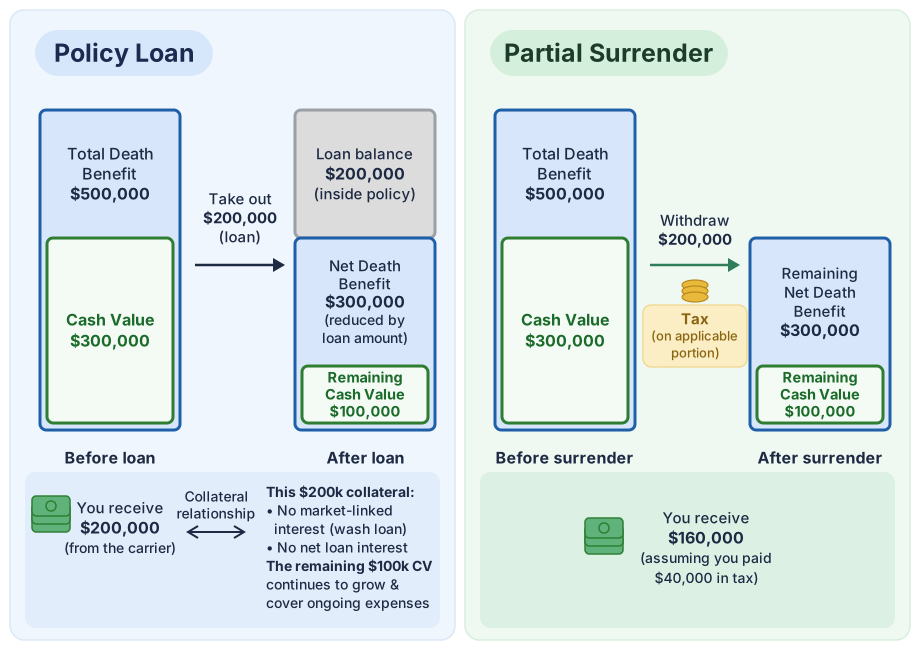
The illustration below shows the same policy after taking out $200,000 each way.
Cash value isn't necessarily the amount you can receive
Your policy may show several different values, including accumulation value, cash surrender value, and loan value. These aren't necessarily interchangeable.
For example, a policy might show $100,000 of policy value but a lower amount available upon surrender because of a surrender charge or other adjustments. We explain why surrendering in a policy's early years is expensive in how much an IUL costs.
When evaluating an IUL, look at the actual amount available under the policy's terms, rather than assuming that the headline cash value is the amount you can take home.
Partial surrender (withdrawal): taking money out
A partial surrender, sometimes called a partial withdrawal, lets you take some money out while keeping the policy in force.
For example, suppose your policy has $100,000 of available cash value and you take out $20,000. You may still have the remaining policy and its death benefit, but the policy's values will generally be lower than they would have been without the withdrawal. Some contracts also reduce the death benefit when you take a partial withdrawal.
The main tradeoff is straightforward: you get cash without creating a loan balance, but you keep less value inside the policy to support future charges and growth.
How are partial withdrawals taxed?
The treatment depends in part on whether the policy is a modified endowment contract (MEC).
For a non-MEC life insurance policy, a partial withdrawal is generally treated as coming from your cost basis first. This is sometimes described as FIFO (first in, first out) treatment.
For example, suppose you have paid $100,000 of premiums and the policy has grown to $140,000. If you withdraw $20,000, that amount would generally come out of your $100,000 basis first, so the withdrawal would generally not be taxable. If you later withdraw another $90,000, the first $80,000 could generally be covered by your remaining basis, while the remaining $10,000 would generally be taxable as ordinary income.
A MEC is different. Distributions generally follow income-first (LIFO) treatment, meaning gains come out before basis. Taxable amounts may also be subject to an additional 10% tax in some circumstances.
Previous withdrawals, loans, exchanges, and other policy changes can complicate the calculation, so specific tax treatment should be confirmed with a qualified tax professional.
Full surrender: ending the policy
A full surrender ends the policy. You give up the coverage and receive its cash surrender value, subject to the policy's terms and any applicable charges or adjustments.
The obvious consequence is that the death benefit ends. You also eliminate the policy's future insurance and administrative costs and can use or invest the surrender proceeds elsewhere.
There can be a significant tax consequence as well. A full surrender can create taxable income when the proceeds exceed your investment in the contract, generally your cost basis.
If you later need life insurance, you would generally have to obtain a new policy, with your age and health potentially affecting eligibility and cost.
Policy loans: accessing cash without surrendering the policy
A policy loan works differently. Instead of taking money directly out of the policy, you borrow against the policy's available value. The policy generally remains in force, while an outstanding loan balance is tracked against it.
The loan typically accrues interest, and the balance can affect the policy's cash value, sustainability, and eventual death benefit.
What is a wash loan?
Some IUL policies offer a wash loan, sometimes called a preferred or zero-net-cost loan. The insurer credits interest to the portion of cash value supporting the loan at a rate that matches, or closely offsets, the interest charged on the loan.
For example, if the policy charges 5% on the loan and credits 5% on the corresponding collateral, the loan has a 0% net interest cost before considering other policy effects.
The exact mechanics vary by policy, and wash loans are only one type of policy loan. We cover wash loans, participating loans, loan interest, and how policy loans affect cash value in How IUL Policy Loans Work →.
The important point here is that a loan gives you cash while keeping the policy in place, but it creates an outstanding balance against the policy.
What can go wrong?
Interest can accumulate. An unpaid loan balance can grow over time.
The death benefit can be reduced. If you die with an outstanding loan, the amount ultimately paid to beneficiaries is generally reduced by the indebtedness.
The policy can become harder to sustain. The policy continues to incur insurance and other charges, and a large loan can reduce the value available to support them. For how large a loan one real policy could carry for the rest of its owner's life, see how much you can borrow from an IUL.
A lapse can create a tax problem. If the policy lapses or is surrendered with an outstanding loan, the tax consequences can be very different from those of a policy that remains in force. Unpaid policy loans are taken into account when determining the policy's taxable gain.
What should you check before taking money out?
Before accessing an IUL's cash value, don't look only at "How much can I get?"
Also check:
1. How much cash will I actually receive? Look at the policy's actual surrender, withdrawal, or loan amount rather than simply its total policy value.
2. What happens to the death benefit? A partial surrender or loan can change the amount your beneficiaries ultimately receive.
3. Can the policy still support itself? Taking money out can reduce the value available to absorb future insurance and other charges.
4. What are the tax consequences? The treatment depends on whether you're making a withdrawal, taking a loan, surrendering the policy, or allowing a policy with an outstanding loan to lapse.
5. What happens if performance is worse than illustrated? An IUL illustration is not a guarantee of future credited interest. A withdrawal or loan can reduce your cushion if the policy performs below the illustrated scenario. We explain how to test a policy against weaker markets in how to stress-test an IUL.
The bottom line
There are two fundamentally different ways to access an IUL's cash value:
- Surrender/withdrawal: take money out of the policy. A partial surrender can keep the policy in force; a full surrender ends it.
- Loan: borrow against the policy while generally keeping it in force, but with an outstanding balance and interest.
The key question isn't just how much cash you can access today, but what happens to the policy afterward.
Before taking money out, look at the effect on cash value, death benefit, policy charges, taxes, and sustainability—especially under scenarios where the policy performs worse than illustrated.
See how you could access your own policy's cash value
Drop your illustration in and we'll show what a surrender would pay you and the most you could borrow without the policy lapsing, year by year — and how much cash value and death benefit remain after each.
For the easiest experience, complete your analysis on a computer.
Drop your illustration here
or click to choose a PDF, up to 25MB