How Much Does an Indexed Universal Life (IUL) Policy Cost? IUL Fees, in Context
Updated:

Table of contents
- What fees does an IUL charge?
- How much does an IUL cost over time?
- Why are IUL fees front-loaded?
- Why does the cost of insurance rise later in life?
- Are IUL fees high when you put them in context?
- Is it fair to compare an IUL's annual fees with the taxes I would owe on the same year's gains?
- How to find out what your own IUL costs
An indexed universal life (IUL) policy doesn't send you a bill for its fees. They come out of the policy quietly, year after year — and the illustration you were given before you bought it prints every one of them. That's where this article reads them from.
We took one real illustration — for a 30-year-old man who does not smoke, with $500,000 of coverage and about $101,000 of premiums paid over the first 4 years — and added up every charge it prints. Over the first 40 years, the policy takes about $36,000 in fees. Held to age 100, it takes about $129,000. The rest of this article is where that money goes, when it goes, and how to judge whether it's a lot.
Every figure below comes from the illustration's own charge columns, at the crediting rate it assumes: 6.59% a year. They're the carrier's current charges, which it can raise up to the maximums the policy guarantees.
What fees does an IUL charge?
Most IUL illustrations print the same handful of charges, year by year. On this policy there are four: a premium charge, a policy fee, a per-unit charge and the cost of insurance.
- Premium charge. A percentage taken off each premium before the rest reaches your account. Here it's 8% of the first premium and 6% of the next three.
- Policy fee. A flat fee, whatever your balance — here about $100 a year, every year.
- Per-unit charge. A charge on the amount of coverage, a little over $2 per $1,000 of death benefit a year. On this policy it runs for the first 10 years, then stops.
- Cost of insurance (COI). What you pay for the death benefit itself. It's charged on the net amount at risk — roughly, the part of the death benefit your own cash value doesn't already cover — at a rate that rises every year as you get older.
Some policies add rider charges, for extras like long-term care coverage. This one has none.
If you're new to how the pieces of an IUL fit together, our guide to understanding IUL walks through the account, the index credit and the death benefit before any of the fees.
How much does an IUL cost over time?
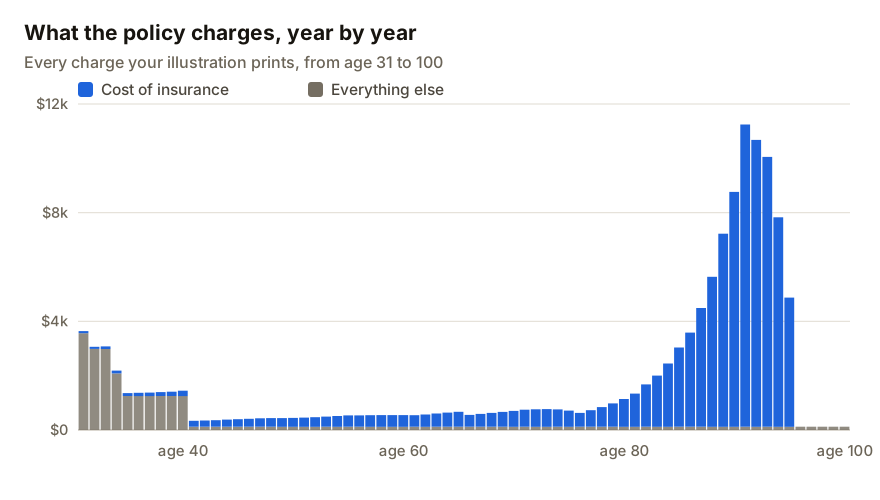
Over its first 40 years this policy takes about $36,000 in fees; held to age 100, about $129,000, most of it after age 70.
The chart above has three distinct stretches, and each one is driven by a different charge.
Years 1 to 10: about $20,000. This is the most expensive decade of the policy's first 40 years. The premium charge comes off every payment, and the per-unit charge runs every year. Almost none of it is the cost of insurance — at 30, insurance is cheap.
Years 11 to 40: about $15,000. The per-unit charge stops after year 10, and the annual fees drop to a few hundred dollars. From year 11 on, the cost of insurance is larger than every other charge combined.
Years 41 to 70: about $94,000. This is where most of the lifetime cost sits. The cost of insurance rises with age and peaks at about $11,000 a year at 91. Then, from age 96, it falls to nothing and only the policy fee remains. On this policy that's because the account has grown far larger than the $500,000 face amount by then. The death benefit is set by the account itself, so the carrier has nothing more to insure.
Why are IUL fees front-loaded?
Because two of the four charges are built to land early. The premium charge only applies while you're paying premiums — here, the first 4 years. The per-unit charge only runs for the first 10. Both are the price of setting the policy up, and both are over by year 11.
That timing matters more than the dollar amount. In year 1, this policy's charges come to about 14% of the cash value in the account. By year 5 they're about 1.3%. By year 11, about 0.2%. By year 40, less than 0.1%. The same charges look very different depending on how big the account is when they land — and in the early years, the account is small.
It's also why surrendering this policy in its first decade would be expensive. We cover that, and the alternative to surrendering — borrowing — in how IUL loans work.
Why does the cost of insurance rise later in life?
Because the rate charged for each year of coverage rises with age, and by your 80s it rises faster than the amount at risk shrinks.
Two things set the cost of insurance each year, and they pull in opposite directions.
The rate rises with age, every year. The net amount at risk it's charged on generally shrinks over the decades as your cash value grows, because the carrier has less of the death benefit to cover out of its own pocket. For a long stretch the two roughly cancel out, which is why the middle of the chart above is so flat.
By your 80s, the rate is rising fast enough that the charge climbs steeply. On a policy funded as heavily as this one, the account eventually grows so large that the death benefit is simply the account itself. The carrier has nothing more to insure, and the charge drops away. On a policy with less in it, that last drop may never come.
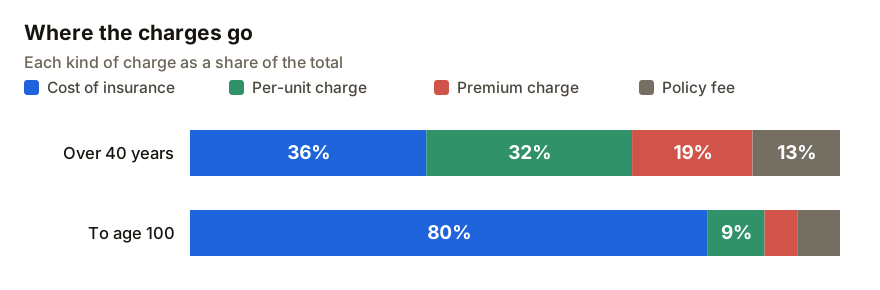
So the answer to "what am I paying for?" depends on how long you keep the policy, as the chart above shows. Over the first 40 years, the cost of insurance is only about a third of the total — the setup charges make up most of the rest. Held to 100, it's about four fifths.
Are IUL fees high when you put them in context?
On this policy, the charges come to about 4% of the interest credited over 40 years, and after the first decade to a fraction of a percent of the cash value each year.
A total like $36,000 means little on its own. Here are two ways to put it on a scale.
Against what the policy earns. Over the same 40 years, at its assumed 6.59%, this illustration credits about $858,000 of interest to the account. The charges come to about 4% of that. Most of the growth stays in the account.
Against the size of the account. After the first decade, the yearly charges on this policy are a fraction of a percent of the cash value: about 0.2% in year 11, and under 0.1% by year 40. For a familiar reference point, a low-cost S&P 500 index fund charges around 0.04% a year — that's the expense ratio of the Vanguard 500 Index Fund Admiral Shares, per its 2026 prospectus. It's tempting to read the two side by side, but they aren't the same kind of cost. An expense ratio pays for running a fund. Much of an IUL's charges pay for something a fund doesn't give you at all: a death benefit — on this policy, about a third of the charges over 40 years, and about four fifths held to 100. A percentage is a useful way to see the scale, not a like-for-like price.
A fund can come with a death benefit of its own, by buying term life insurance beside it. Our article on buying term and investing the rest vs. an IUL compares this same policy with a $500,000 term policy plus an S&P 500 index fund, so both sides pay for coverage.
Neither of these makes the fees cheap or expensive in general. They describe this one policy, funded heavily and early — which is how the costs stay small against a large account. A policy funded closer to the minimum, or bought at an older age, spreads the same kinds of charges over a much smaller account, and the percentages come out very differently.
Is it fair to compare an IUL's annual fees with the taxes I would owe on the same year's gains?
No. Setting one year's fees against a year's tax on the same gains overstates the tax, because an index fund you buy and hold isn't taxed on its growth each year either.
There's a common way to make an IUL's fees look small, and it's worth taking apart.
The argument goes like this: an IUL's cash value grows without being taxed each year. So set the year's fees against the tax you'd have paid on the same gain in an ordinary brokerage account. On this illustration, the comparison looks lopsided. In year 30, the policy credits about $31,000 of interest and takes a few hundred dollars in charges. Taxed as ordinary income at 37% — the rate our analyzer assumes until you enter your own — that same $31,000 would cost about $11,000. Put that way, the fees look like a bargain.
It isn't a fair comparison, because nobody has to pay that $11,000. If you buy an index fund and hold it, its growth isn't taxed in the year it happens. You pay capital-gains tax when you sell — possibly decades later, and at the long-term rate rather than the ordinary one. What a buy-and-hold account does pay tax on each year is its dividends. But the policy doesn't credit you dividends at all, because its index account follows the index's price alone.
So deferring tax isn't something only the policy does — holding an index fund defers it too. The real tax differences between the two come later: how you take the money out, and whether it's taxed when you do. A fair comparison isn't one year's fees against one year's tax. It's what you end up with from each after every fee and every tax, when you actually take the money out — and that depends on how long you hold and on your own tax rates.
How to find out what your own IUL costs
Every figure in this article came from one illustration. Yours has its own charges, its own premium schedule and its own assumed crediting rate, and the totals can come out very differently. Everything you need is already printed in your illustration — it's just spread across many columns and pages.
See what your own IUL costs
Drop your illustration in and we'll break down every fee it charges, year by year — and compare it fairly with investing the same money yourself, after every fee and every tax, at your own tax rates.
For the easiest experience, complete your analysis on a computer.
Drop your illustration here
or click to choose a PDF, up to 25MB