Indexed Universal Life (IUL) Death Benefit Options: How Do Level and Increasing Death Benefits Work?
Updated:

Table of contents
- What is a level death benefit (Option A) in an IUL?
- What is an increasing death benefit (Option B) in an IUL?
- What is the difference between level and increasing death benefits (Option A vs. Option B)?
- Does an increasing death benefit cost more?
- How much does an increasing death benefit cost on a real policy?
- Why would someone choose a level death benefit?
- Why would someone choose an increasing death benefit?
- Does a level death benefit always stay exactly the same?
- What happens to the death benefit when cash value grows?
- Can I change the death-benefit option later?
- The bottom line
When you look at an IUL illustration, the death benefit may seem straightforward: it is the amount your beneficiaries receive if you die while the policy is in force.
But an IUL can be structured with different death benefit options, and the choice affects how the death benefit changes as the policy's cash value grows.
The two common choices are a level death benefit and an increasing death benefit.
Understanding the difference is important because it affects not only the amount of insurance you have, but also the amount of insurance you are paying for.
What is a level death benefit (Option A) in an IUL?
With a level death benefit, the policy is generally designed to keep the death benefit around the policy's specified amount.
For example:
Specified amount: $500,000
Cash value: $150,000
Death benefit: approximately $500,000
If the cash value later grows to $300,000, the death benefit does not normally become $800,000. It generally remains around the specified amount.
This structure is commonly called Option A, although the exact terminology varies by insurer.
A simplified way to think about it is:
Level death benefit ≈ specified amount
There is an important exception: a level death benefit can eventually be forced higher by the policy's cash value corridor. That is a separate issue covered in the article on how the IUL corridor works.
What is an increasing death benefit (Option B) in an IUL?
With an increasing death benefit, the death benefit generally grows as the policy's cash value grows.
For example:
Specified amount: $500,000
Cash value: $150,000
Death benefit: approximately $650,000
If cash value later grows to $300,000, the death benefit could be approximately:
$500,000 + $300,000 = $800,000
This structure is commonly called Option B, although terminology varies by insurer.
Insurers also use their own word for the cash value in Option B. National Life defines it as "the face amount plus the accumulated value" [1], and F&G, for its Pathsetter IUL, as the face amount plus the account value [2]. The face amount is another name for the specified amount. So whether an illustration says specified amount plus account value, face amount plus accumulated value or death benefit plus cash value, it describes the increasing death benefit, Option B.
The important idea is that the cash value becomes part of the death benefit rather than simply accumulating underneath a relatively fixed death benefit.
Sources. [1] National Life Group, "Death Benefit Option", the help page for its universal life illustrations, read October 2026: Option B is "the face amount plus the accumulated value". [2] F&G, "F&G Pathsetter At-A-Glance", form ADV2260, revised March 2026: Option B is the greater of the face amount plus the account value and the minimum death benefit required by law.
What is the difference between level and increasing death benefits (Option A vs. Option B)?
The basic difference is what happens as cash value grows: a level death benefit stays around the specified amount, while an increasing one grows with the cash value.
| Level death benefit | Increasing death benefit | |
|---|---|---|
| Basic design | Death benefit stays around the specified amount | Death benefit grows with cash value |
| Cash value added to DB? | Generally no | Generally yes |
| Amount of insurance | Relatively stable | Increases as cash value grows |
| Insurance exposure | Generally lower | Generally higher |
| Common designation | Option A | Option B |
The exact contractual formula can differ between policies, so the policy's actual definitions should always take precedence over these simplified descriptions.
Does an increasing death benefit cost more?
It can. With an increasing death benefit, the net amount at risk, the part of the death benefit above the cash value that the cost of insurance is charged on, does not shrink as the cash value grows.
One reason is the net amount at risk (NAR).
Very roughly, NAR represents the amount of death benefit that the insurer is providing beyond the policy's accumulated value.
For example:
Death benefit: $700,000
Cash value: $200,000
Approximate amount at risk: $500,000
If the death benefit increases while cash value stays the same, the insurer is potentially taking on more insurance risk.
That can affect the policy's cost of insurance and other charges.
We explain the net amount at risk from first principles in how life insurance works, and how the cost of insurance is charged on it in how much an IUL costs.
This is why comparing only the projected death benefit is incomplete. A larger death benefit can also mean that more insurance is being carried inside the policy.
How much does an increasing death benefit cost on a real policy?
On one real illustration, the same premiums with an increasing death benefit would have given the policy at age 70 about $310,000 more death benefit, but about $42,000 less cash value. What is slightly counterintuitive is that the larger death benefit comes with a smaller cash value, not a larger one: the increasing option keeps more insurance in force every year, so it is charged more for the cost of insurance, and those charges come out of the cash value, so less of it grows.
We compared two versions of one real policy that differ only in the death benefit option: a 30-year-old man who does not smoke, a $500,000 specified amount, and about $101,000 of premiums paid over the first 4 years.
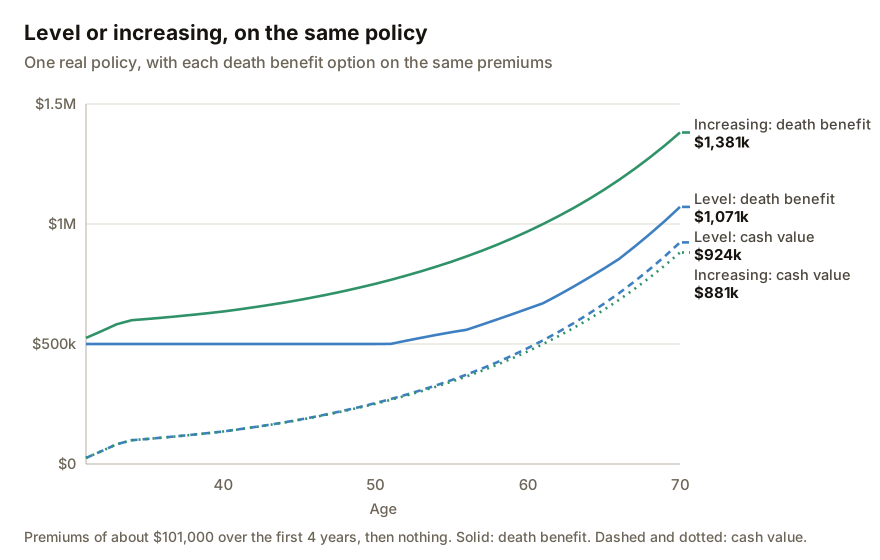
As shown above, the two cash values stay close, but the increasing option's falls a little further behind every year. With the increasing option, the net amount at risk stays at the full specified amount, while with the level option it shrinks as the cash value grows, so over the first 40 years the increasing option is charged more than twice as much for the cost of insurance.
The extra death benefit does not last forever. Because the level policy keeps more cash value, the corridor eventually lifts its death benefit past the increasing one: by about age 90, the level policy has both the larger death benefit and more cash value. (The level death benefit in the chart starts rising around age 50 for the same reason; our article on the cash value corridor explains how it works.) Before then, the trade holds: the increasing option buys more coverage through your 70s and 80s, and the level option keeps more cash value.
Why would someone choose a level death benefit?
A level death benefit can be useful when the primary objective is maintaining a specified amount of life insurance rather than continually increasing the amount of coverage.
As cash value grows, the policy does not generally need to provide as much additional insurance.
This can make the economics different from an increasing death-benefit design.
For someone primarily interested in cash accumulation, the distinction can therefore be particularly important: the death benefit is still part of the insurance contract, and the amount of insurance being provided can affect the policy's costs.
Why would someone choose an increasing death benefit?
An increasing death benefit is designed to provide more life insurance coverage as the policy’s cash value grows. This can make sense when the amount of protection you need is expected to increase over time.
For example, someone might choose an increasing death benefit because they want to:
- Keep up with inflation. A fixed $1 million death benefit will generally buy less in the future than it does today. An increasing death benefit can provide additional coverage as time passes.
- Build in growing protection. Someone early in their career may expect their income, assets, debts, or financial responsibilities to grow over time. Increasing coverage can provide a larger death benefit without requiring the policyholder to predict the exact amount of future coverage needed today.
- Provide additional protection as cash value accumulates. With an increasing death benefit, the cash value is generally added to the policy's base death benefit, rather than replacing part of it. This can allow the policy to provide both growing cash value and a growing death benefit.
- Pass on a larger legacy. Someone whose primary goal is ultimately to pass wealth to beneficiaries may prefer a death benefit that grows alongside the policy rather than remaining fixed.
There is an important trade-off, however. An increasing death benefit generally requires the insurer to provide more insurance as the policy's cash value grows. That can increase the policy's cost of insurance and other charges compared with a comparable policy with a level death benefit. The difference can affect how efficiently premiums build cash value.
In other words, an increasing death benefit is not automatically "better" simply because the death benefit is larger. It is a different way of allocating the policy's economics between insurance protection and cash-value accumulation.
The right question is therefore not just "How large can the death benefit become?" but "Do you actually need the additional protection, and is the additional insurance cost justified by your objective?"
Does a level death benefit always stay exactly the same?
No. The tax code's cash value corridor can force a level death benefit higher once the cash value grows large enough.
This is one of the most important qualifications.
A level death-benefit option does not mean that the death benefit can never increase.
Federal tax rules require a minimum relationship between a policy's death benefit and cash value for the contract to qualify as life insurance under Internal Revenue Code §7702.
This is commonly known as the cash value corridor.
If the cash value becomes sufficiently large relative to the specified amount, the death benefit may have to increase even though the policy uses a level death-benefit option.
For example, a policy might start with:
Specified amount: $500,000
Death benefit: $500,000
Years later, if cash value becomes sufficiently large, the death benefit could rise above $500,000 to satisfy the applicable corridor requirement.
This does not mean the policy has changed to an increasing death-benefit option.
It is a separate tax-driven requirement. We show the corridor doing this on one real illustration in why an IUL death benefit can increase.
What happens to the death benefit when cash value grows?
It depends on the death-benefit option: with a level option, the death benefit generally stays where it is while the cash value grows underneath it; with an increasing option, it grows alongside the cash value.
There is therefore an important difference between:
“The policy has a larger death benefit because I selected an increasing option.”
and
“The policy's death benefit increased because the corridor required it.”
Those are two different mechanisms.
Can I change the death-benefit option later?
Many universal life policies permit the owner to request a change in death-benefit option, but the exact rules depend on the contract and insurer.
Changing the option can affect:
- death benefit,
- net amount at risk,
- cost of insurance,
- policy charges,
- cash value,
- premium requirements,
- and potentially tax treatment.
Some changes may also require underwriting or insurer approval.
Therefore, changing the option should be evaluated as a change to the policy's economics, not simply as a change to one line in the illustration.
The bottom line
Think of the two options this way:
Level: “I want roughly the same amount of life insurance while the policy accumulates cash value underneath it.”
Increasing: “I want the amount of life insurance to grow as the policy accumulates cash value.”
Neither description tells you whether the policy itself is economically attractive. For that, you also need to examine premiums, charges, cash-value growth, guarantees, and sustainability.
The death-benefit option simply tells you how the insurance component is intended to behave.
And even with a level option, the death benefit may eventually rise because of the cash value corridor—a separate mechanism that becomes especially important as cash value grows and the insured ages.
See how your own policy's death benefit develops
Drop your illustration in and we'll chart its death benefit and cash value year by year across every market we test, against buying term coverage and investing the difference.
For the easiest experience, complete your analysis on a computer.
Drop your illustration here
or click to choose a PDF, up to 25MB